Unconferences: A Better Way to Run Meetups (28/30)
I'm writing 30 posts in 30 days at Inkhaven. This is number 28.

Over the last two years I ran 20+ meetups, most with 40-90 people. I also attended a few dozen more.
A typical meetup starts with a talk, followed by socialising: people mixing and mingling in loose circles.
People really like the idea of talks — it’s great to have a specific reason for coming to a meetup. But think about the most fun and useful meetups you’ve attended: were they great because of the talk, or because of the conversations you had afterwards?
For me, the answer is the conversations. It’s amazing when the talk is engaging, but if the conversations afterwards lack depth, I might as well have watched a video on YouTube.
Meetup organisers significantly underinvest in making sure the post-talk conversations are great and people connect with each other. And there’s a simple way to upgrade that socialising part: turn it into an unconference.
Unconferences
An unconference is usually defined as “a participant-driven conference with a write-in schedule on a wall”.
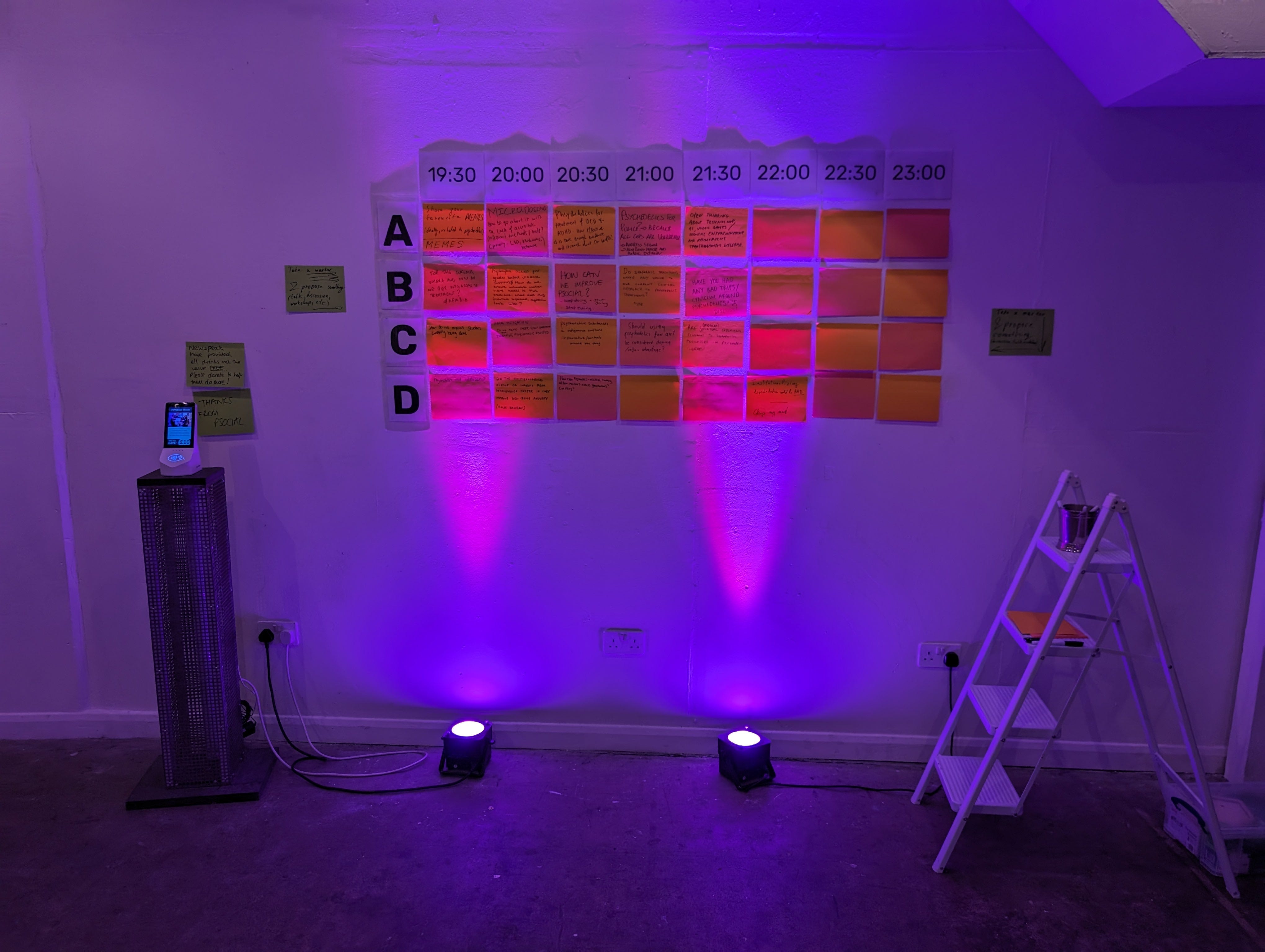
I ran 10+ of these and here is how they look. There are a few tables labeled A, B, C, …. On a wall there is a schedule made from large sticky notes (A5 / 15×21 cm) arranged in a rectangular grid — the start times are at the top, and the table labels are on the left. There are plenty of markers nearby so people can write things on the schedule — and there is a note encouraging them to do so.
At any point of the event, anyone can claim an empty slot and propose a session: a discussion on a topic, a mini-talk, playing a board game or even silently meditating together.
In my experience, 95% of sessions end up being discussions around a topic. Despite having the word “conference” in the name, an unconference ends up very different from its parent concept. The schedule becomes a matchmaking service to help people find others who want to talk about the same things. Attending sessions is optional — if you run into someone you want to continue talking, you can skip the next session.
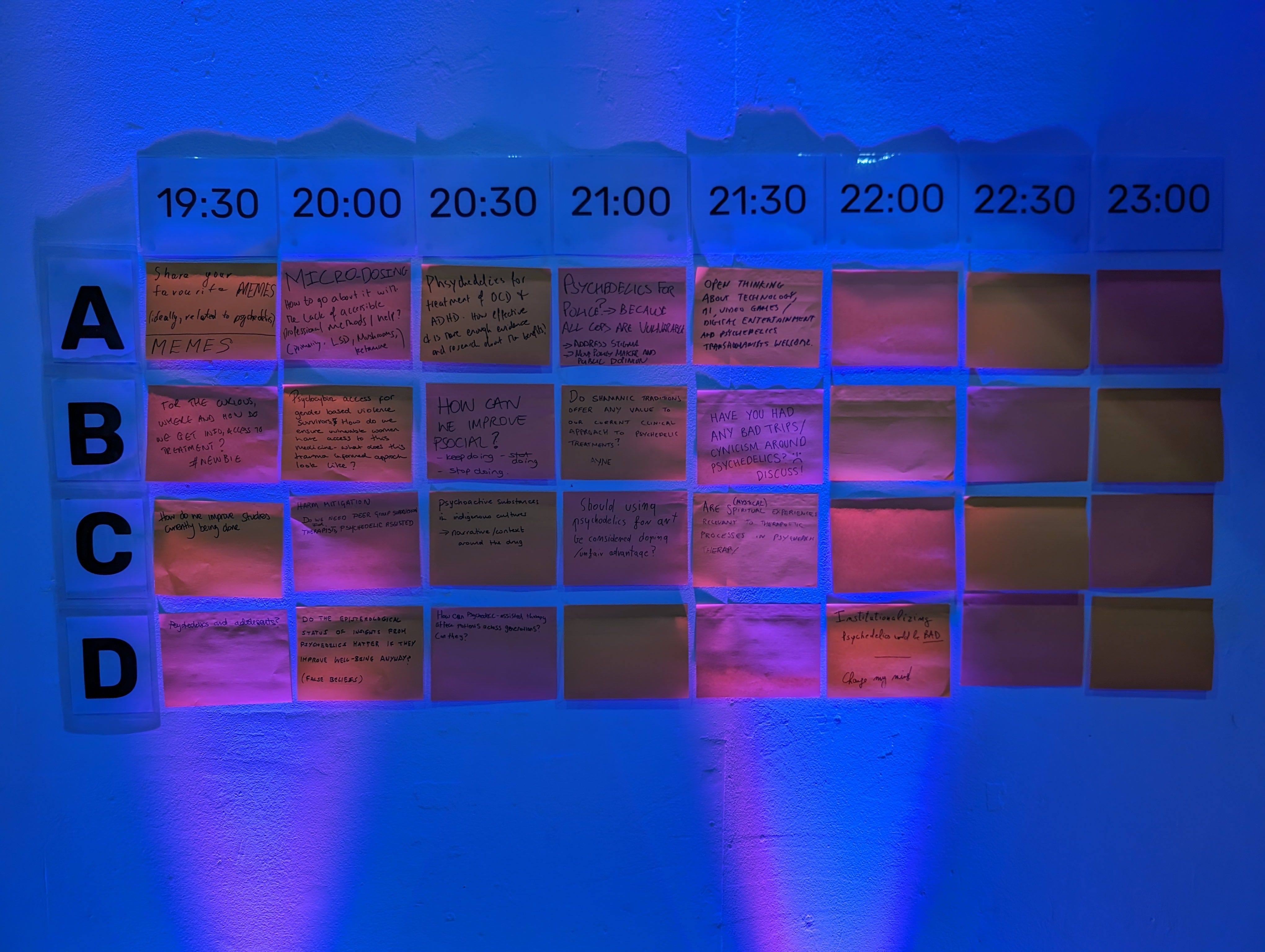
I find that people put a lot of sessions in the early slots, and the later slots end up being mostly empty. People find circles they enjoy and just keep going. This is a feature and not a bug: there’s no need for this structure once attendees find interesting people and engaging conversations. Essentially, unconferences “default” to regular old unstructured discussion circles when this makes sense.
Typically, the person who proposes a topic also ends up running the session. But a classic unconference experience is arriving at a table and finding that the original proposer isn’t there. This rarely a problem — people figure this out, often the person most knowledgeable on the topic volunteers to be a moderator.
In my experience, the minimum meetup size where an unconference makes sense is about 25 people. Below that, there isn’t much advantage to it: there will be very few sessions, and everyone can talk to everyone anyway. And ideally, you need 40+ attendees — that’s when you get a diversity of topics on the schedule and the unconference format really starts to shine.
Tips for Meetup Organisers
An unconference requires minimal preparation. But there is a bit of a learning curve when it comes to actually running one: you have to keep time and explain the format. Here are my tips that’d make your first unconference a smoother experience.
Signal the time slots clearly. Participants generally won’t keep track of time. As an organiser, you need a way to signal when slots end. I use a gong and walk across the space, gently striking it at the end of each session.
Explain the format more than once. If you have a talk or another shared activity, I recommend explaining unconferences both before and after it. Also, hanging out near the schedule to answer questions helps. If you already have an existing community (e.g. on WhatsApp), I recommend informing people in advance. Also, briefly explain unconference in the event description: here are my two example events: a Qualia Research Institute meetup or a Cognitive Security meetup.
Invite participation explicitly. Reassure participants that anything goes when it comes to topics, they don’t have to be experts on it to run a session. Make sure you have a note on the wall explicitly inviting participation. Mine usually says “Take a marker and propose something”
Pre-seed the schedule. Put a few topics you’re personally interested in on the schedule before participants arrive, so it doesn’t look empty. Plan to run these sessions yourself.
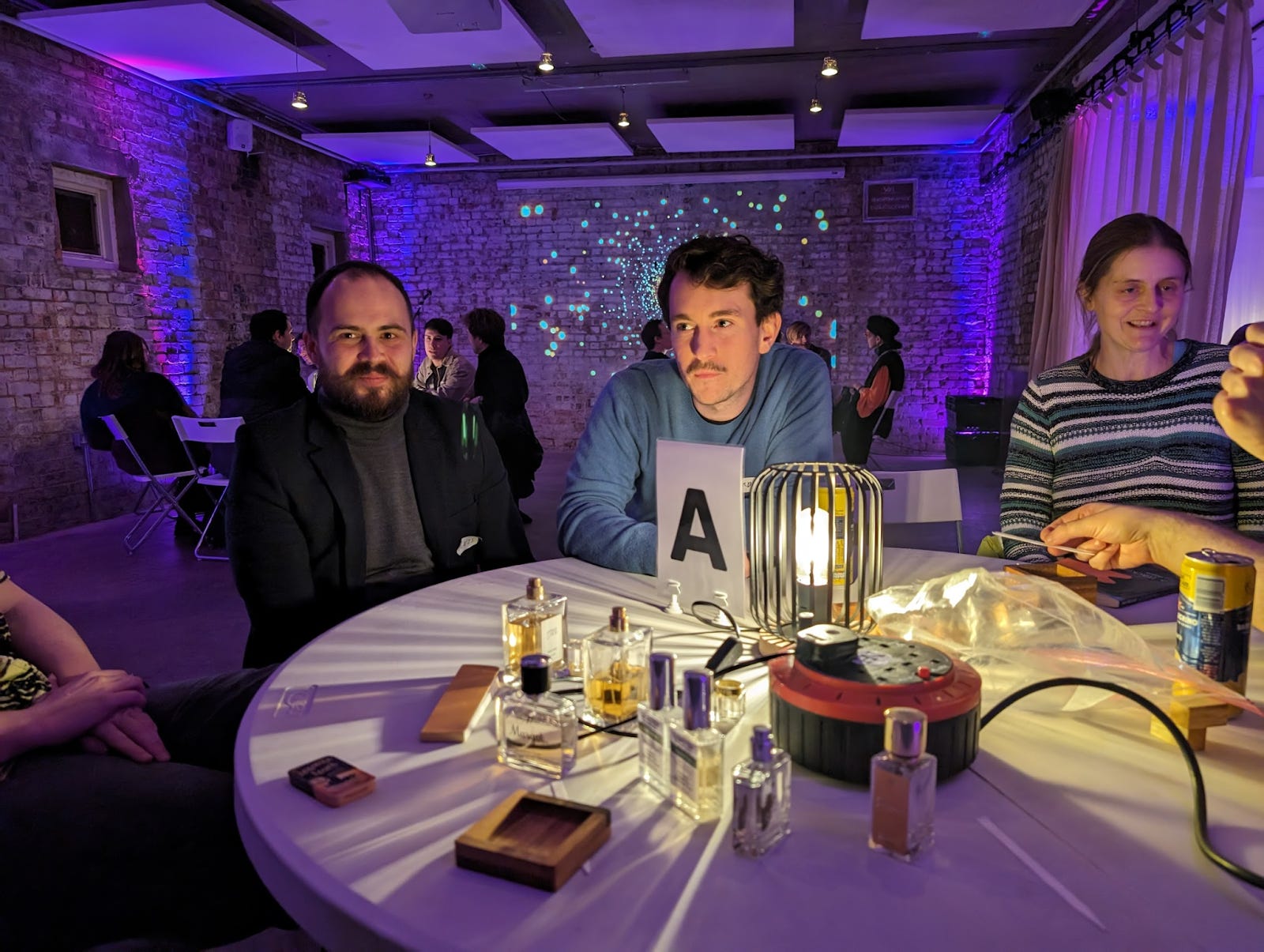
Consider getting creative with sessions you run. 95% of sessions are discussion around a topic — absolutely nothing wrong with this. But as an organiser, you might find cheap ways to run other types of sessions. For example, I occasionally run scent bars — getting attendees to smell my collection of essential oils and aroma chemicals and telling them about it.
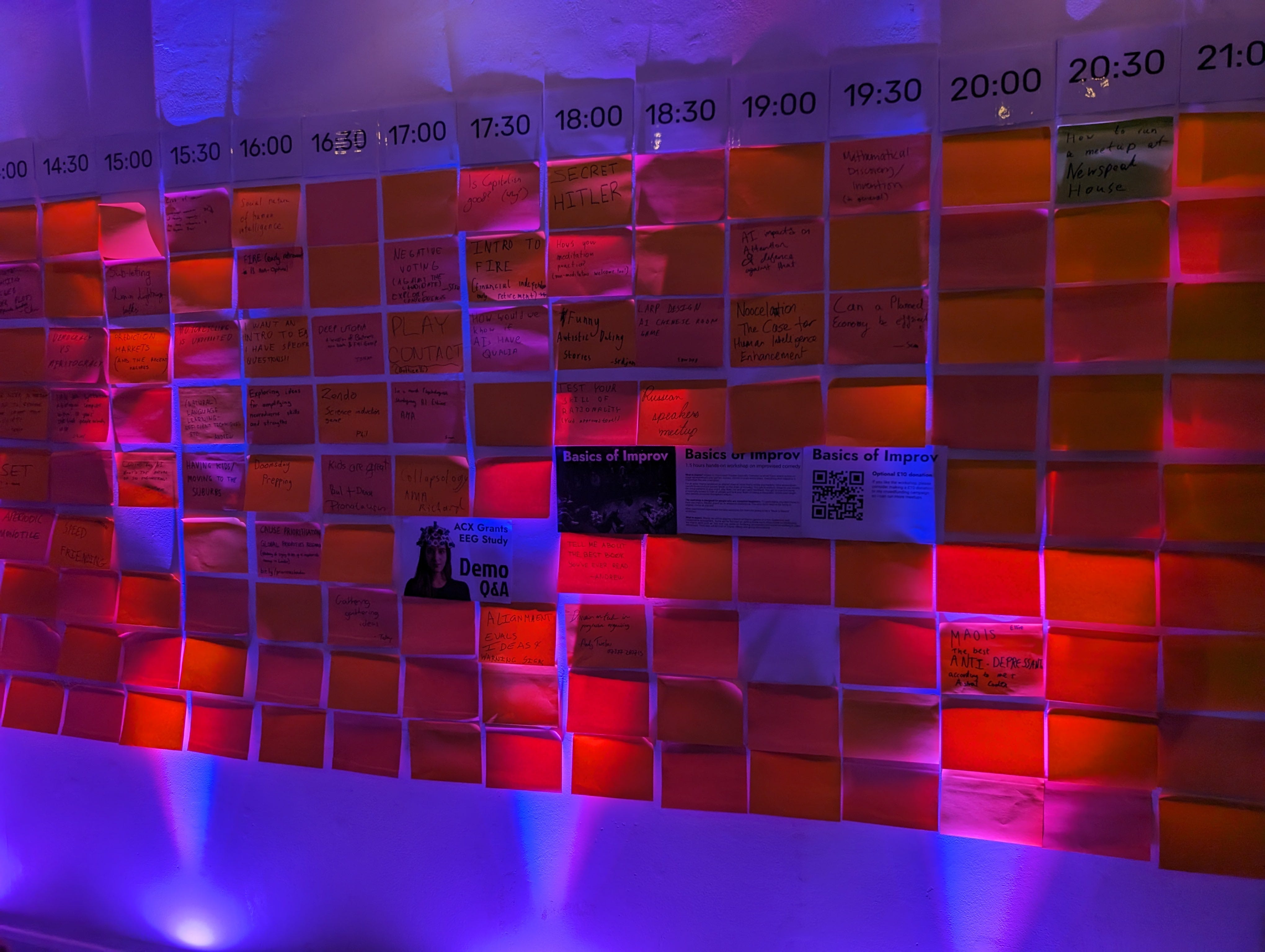
A talk or another shared activity isn’t required. A talk followed by an unconference is often the best combination, but the format works on its own — just make sure you invest time into explaining it to attendees. Case in point: the schedule below is from a 100+ people meetup that was an unconference-only one.
Consider sending this post to your local organiser
An unconference is a low-tech and powerful way to make a meetup more serendipitous by increasing chances like-minded people find each other. If you are a meetup organiser — consider running an unconference at your next event.
And if you’re an attendee, consider sending this post to your local organisers. I myself will be definitely doing this. I wrote this post for selfish reasons: I want better, deeper conversations at the meetups I go to.
Thank you for your service, Sasha! Your meetups are making waves! (And maybe someday we'll be able to visualize them too... partly thanks to the connections made in such meetups leading to better wave visualization software). :-)